Showing posts with label interns. Show all posts

Thursday, February 24, 2022

The Acquaintance of Charlie Gibson, Jr. and Isabella Stewart Gardner

Oftentimes visitors to the Gibson House Museum ask our guides about Charlie Gibson Jr.’s relationships with other well-known Bostonians, especially Isabella Stewart Gardner. Although the two were neighbors for nearly forty years, there is not much evidence that they were close. (Isabella Stewart Gardner was both a generation older than Charlie and was part of a higher social class.) There is, however, evidence that they were acquaintances. Isabella Stewart Gardner was, and still is, considered one of the most prominent, and perhaps
Drawing Room at 152 Beacon Street, 1900.
Image: Gardner Museum
eccentric, members of Boston’s elite in the nineteenth and twentieth centuries. She was born in New York City in 1840 to a wealthy family. In 1860, just before she turned twenty, she married Jack Gardner and they moved to Boston, to 152 Beacon Street in the Back Bay. Although the couple traveled abroad quite a bit, Beacon Street was their home until Jack’s death in 1898, after which Isabella purchased land in the Fens for the museum and home they had been planning. During this same period, Charlie Gibson was born (1874), grew up in the Back Bay at 137 Beacon Street, and went on the trip to France which inspired his travelogue,
Two Gentlemen in Touraine (1899). The Gibson family lived just two blocks from the Gardners during the entire time they resided in the Back Bay.

Wednesday, December 22, 2021

To Mold or Not To Mold: A History of Food Molds from the Victorian Era to Today

The kitchen pantry at the Gibson House stores an extensive collection of food molds. While the preponderance of these molds are metal, their form and decoration change depending on their purpose. Ranging from simple lady finger pans to ornamental scaled fish, they provide insight into how function and entertainment converged upon Victorian food culture.

One notable feature of these objects is their versatility. Molds made of copper, pewter, or tin could be used for the baking, steaming, and setting of jellies, cakes, custards, and puddings. One type of mold in the Gibson kitchen is an ice cream mold, a technology pioneered by Agnes Marshall. Her 1885 seminal work, The Book of Ices: Including Cream and Water Ices, Sorbets, Mousses, Iced Souffles, and Various Iced Dishes, showed readers how to use her inventions, including molds and ice cream freezers, alongside recipes. Molded foods were conveniently labor saving for kitchen staff and women homemakers. They could be prepared around a day before the meal, then the mold could be removed just before serving.

Thursday, July 15, 2021

In Sickness and In Health: Dr. Freeman Allen, Mary Ethel Gibson, and Mental Health and Addiction

This blog post is part of an occasional series about the Gibson House Museum Archives, a repository of personal documents and photographs from the Gibson family. The archives are accessible by appointment; contact mgholmes@thegibsonhouse.org to make arrangements.

“I said that although I had always thought that it might be best to resume work in Anesthesia on a moderate scale, that you had absolutely declined to have me do this and that I had definitely made up my mind to be guided by you in the matter, and that of course if you did not want me to do it and would not stand for it, that settled it. 

 . . . 

I will now follow your advice and take a rest before the walk which I hope will take place. 


I am, darling little Wesscat, with more love and gratitude than I ever felt before in my life, and many kisses for your sweet little self, 


Your affectionate husband 

Freeman”

Gibson House Museum Archives.

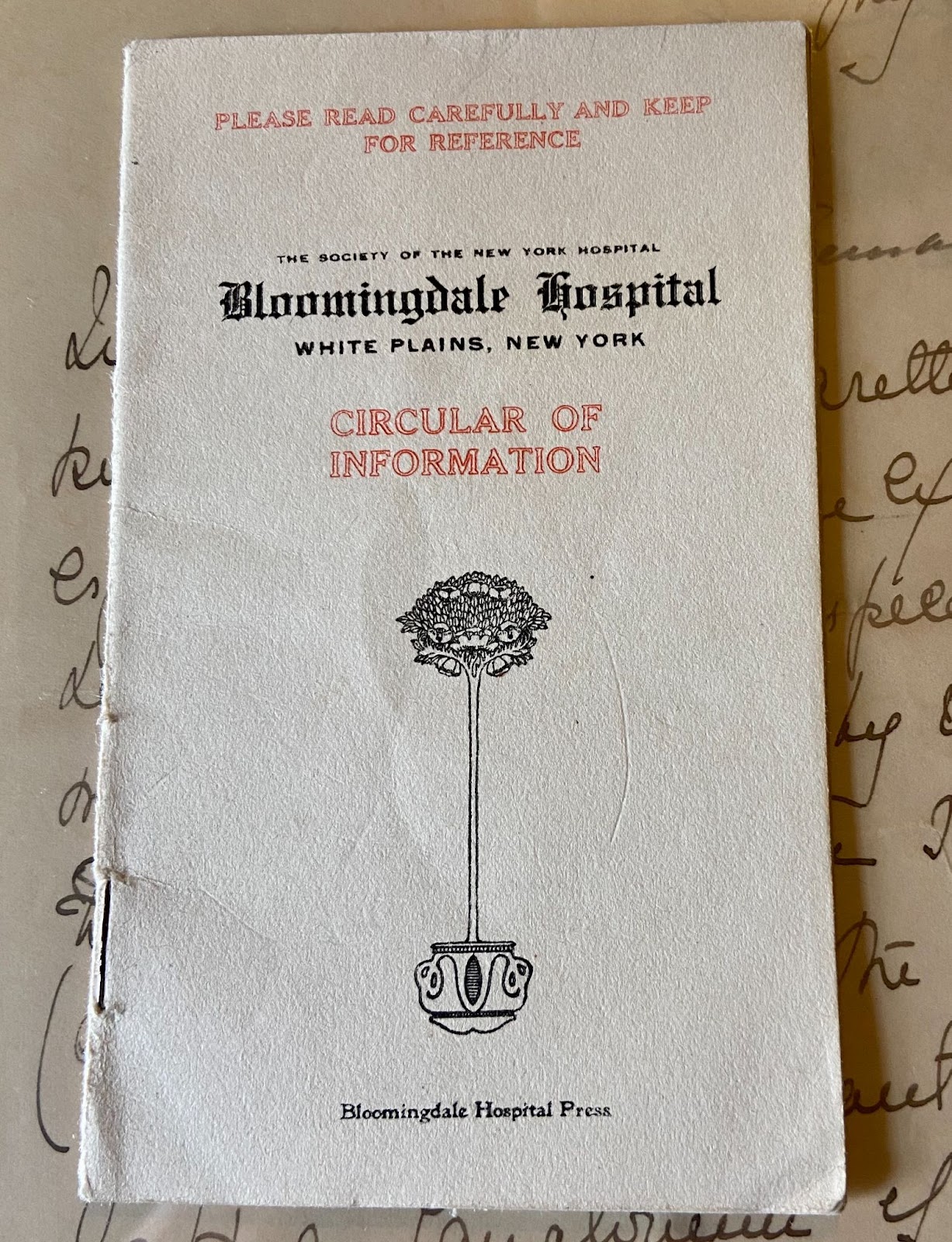
Dr. Freeman Allen wrote these words to his wife, Mary Ethel Gibson Allen, in 1926 while he was a patient at Bloomingdale Hospital in New York. A physician and pioneer in the anesthetics field, Freeman suffered from depression and narcotic addiction, and he spent the last five years of his life being treated in institutions. Throughout it all, he wrote letters to his wife, updating her on his health as well as relaying mundane matters like requests for bowties and candies. As an intern at the Gibson House Museum this spring, I was tasked with reorganizing the over 400 letters that comprise the Mary Ethel Gibson Allen and Dr. Freeman Allen correspondence sub-series. The letters span thirty-six years, starting with their over decade-long courtship and ending with his death by suicide in 1930. The true story of his death was discovered by the museum just a handful of years ago; this revelation is recounted in a blog post here. My work in the archives this semester allowed me to follow Freeman and Mary Ethel’s relationship from its timid beginnings to its resilience in the face of illness and shame.

Friday, April 2, 2021

1898 Mangle: Laundry Is the Mother of Invention

Have you ever wondered what doing laundry was like in the 1800s? Today, most laundry routines consist of shifting clothes between washing machines and dryers. But what kind of technology was involved in laundry in the nineteenth century?

Trade card for the Bench Wringer
Collection of Historic New England
Laundry in the Victorian era would have been a very time-consuming process. Collecting, cleaning, and drying out the clothes would have taken hours. According to The Library Company of Philadelphia, “clothes would be soaped, boiled or scalded, rinsed, wrung out, mangled, dried, starched, and ironed, often with steps repeating throughout.” Victorian clothing often included delicate fabrics, intricate detailing, and unique closures, all of which would have affected how a garment was cleaned. Making laundry even more challenging was the fact that many households in the 1800s did not have running water.

Friday, April 26, 2019

Finding Old-School Fashion in the Fast-Paced World

Getting dressed in the 1860s and 1870s was a complicated process. Women’s fashion included many layers and separate articles that combined to form the perfectly assembled outfit, or “costume,” as we refer to it in museums. The Gibson family women had access to designer clothing and custom-tailored dresses and gowns, which they wore to showcase their social status and fit into society. Each piece of clothing had a specific purpose or occasion to be worn. Opera gowns, morning gowns, day dresses, and tea gowns were all popular styles in the 1860s and 1870s. Much of the clothing in the Gibson House Museum’s collection dates from the 1870s and 1880s, when the matriarch, Catherine Hammond Gibson, and her daughter-in-law, Rosamond Warren Gibson, lived in the house together.  
           
Turquoise bodice, c.1870s
Gibson House Museum (2019.3)
When I first began cataloging the clothing from the Gibson House Museum’s collection, I was overwhelmed with how to begin. I soon found that it was not as complicated as I’d thought; cataloging artifacts is as simple as assigning an accession number and recording details about the object.

One of the first articles of clothing I cataloged was a beautifully detailed turquoise dress that has aged rather poorly. There are some tears and discolorations in the fabric, which make it more difficult to picture how it would have been worn in the 1870s or 1880s. Like many of the dresses from the Gibson House Museum’s collection, it was taken apart, either to be washed or because alterations needed to be made. Although some of the fabric is in poor condition, as a whole, the dress is exquisite; its delicate silk fringe and vivid color caught my eye.

Friday, August 25, 2017

Lithophane: Narrative Encased in Porcelain


The lithophane lamp in the Music Room is a hidden gem of tours at the Gibson House. In fact, while opening up the museum for the day and turning on all the lights in the house, I make it a point to leave this particular lamp off. This, of course, can sometimes lead to visitors being puzzled as to why I have gathered them in one corner of the Music Room to look at a small, seemingly simple lamp. However, the theatrics of pulling the metal chain with a dramatic flourish and waiting for the visitors to express their surprise continues to be one of my favorite parts of giving tours.