Showing posts with label 20th century. Show all posts

Tuesday, September 10, 2024

Mary Ethel Gibson: An Emblem of Boston's Victorian Era

The research for this blog post was conducted in preparation for an interview with the What’s Her Name podcast in 2023. To learn more fascinating details about Ethel’s life, listen to their episode, “The Boston Brahmin.”

Ethel and husband Freeman Allen, c.1925
Gibson House Museum
Mary Ethel Gibson, born in 1873—and more often referred to as Ethel by friends and family—was brought into a world on the precipice of great change. Over the course of the first few decades of her life the telephone was invented, as was the automobile and kodak camera; electricity made its way into homes; and even the first airplane took flight. The city of Boston itself was also changing, as waves of immigration created a massive population boom, which not only encouraged the city to create the Back Bay neighborhood that Ethel would spend her entire life in, but also created new social pressures that sparked various progressive movements. At the Gibson House, as we have begun to uncover more details about Ethel’s life, we can see the ways in which she navigated these changes, both by holding on to the traditions she grew up with and by taking advantage of the newfound freedoms afforded to her in the 20th century. Ethel’s community and her status in society informed and shaped her life during such rapidly changing times. In many ways, Ethel and her experiences during the 19th and 20th centuries are emblematic of Boston’s Victorian era, but she was also an individual who made individual choices. No one person’s story is enough to understand any period of history, but knowing more about Ethel and her life not only expands our understanding of the Gibson House and the Gibson family, but also the greater world they occupied.

Friday, April 29, 2022

The 19th Century Allure of Roman Ruins

This blog post is one of a two-part series on collections at the Gibson House Museum from Italy.

In 1898, after a year of study at MIT for architecture, Charlie Gibson took an extended trip to Europe. It was common for wealthy American men to make such a trip—to cap off their education and before settling down to work and family—known in nineteenth-century parlance as a Grand Tour. The Grand Tour could include a variety of European destinations (some even traveled as far as Turkey), but the essential stops were London, Paris, Venice, and Rome. Travel to Rome, in particular, was seen as a chance to complete a classical education, specifically through study of the architecture and history of ancient Rome.

Traveling to Rome was difficult in the nineteenth century. A robust tourist industry had developed by the eighteenth century, and yet transportation, lodging, and access to reliable guides remained sketchy. Some Italian architects and artists made a living serving Grand Tourists. Giovanni Batista Piranesi was one. Starting as early as 1740, Piranesi worked in Rome producing views of the ancient Roman ruins. For many, Piranesi’s depictions of Rome were the way they imagined and understood the city.
Veduta dell'Anfiteatro Flavio, c. 1771
Giovanni Batista Piranesi

Thursday, February 24, 2022

The Acquaintance of Charlie Gibson, Jr. and Isabella Stewart Gardner

Oftentimes visitors to the Gibson House Museum ask our guides about Charlie Gibson Jr.’s relationships with other well-known Bostonians, especially Isabella Stewart Gardner. Although the two were neighbors for nearly forty years, there is not much evidence that they were close. (Isabella Stewart Gardner was both a generation older than Charlie and was part of a higher social class.) There is, however, evidence that they were acquaintances. Isabella Stewart Gardner was, and still is, considered one of the most prominent, and perhaps
Drawing Room at 152 Beacon Street, 1900.
Image: Gardner Museum
eccentric, members of Boston’s elite in the nineteenth and twentieth centuries. She was born in New York City in 1840 to a wealthy family. In 1860, just before she turned twenty, she married Jack Gardner and they moved to Boston, to 152 Beacon Street in the Back Bay. Although the couple traveled abroad quite a bit, Beacon Street was their home until Jack’s death in 1898, after which Isabella purchased land in the Fens for the museum and home they had been planning. During this same period, Charlie Gibson was born (1874), grew up in the Back Bay at 137 Beacon Street, and went on the trip to France which inspired his travelogue,
Two Gentlemen in Touraine (1899). The Gibson family lived just two blocks from the Gardners during the entire time they resided in the Back Bay.

Wednesday, December 22, 2021

To Mold or Not To Mold: A History of Food Molds from the Victorian Era to Today

The kitchen pantry at the Gibson House stores an extensive collection of food molds. While the preponderance of these molds are metal, their form and decoration change depending on their purpose. Ranging from simple lady finger pans to ornamental scaled fish, they provide insight into how function and entertainment converged upon Victorian food culture.

One notable feature of these objects is their versatility. Molds made of copper, pewter, or tin could be used for the baking, steaming, and setting of jellies, cakes, custards, and puddings. One type of mold in the Gibson kitchen is an ice cream mold, a technology pioneered by Agnes Marshall. Her 1885 seminal work, The Book of Ices: Including Cream and Water Ices, Sorbets, Mousses, Iced Souffles, and Various Iced Dishes, showed readers how to use her inventions, including molds and ice cream freezers, alongside recipes. Molded foods were conveniently labor saving for kitchen staff and women homemakers. They could be prepared around a day before the meal, then the mold could be removed just before serving.

Thursday, July 15, 2021

In Sickness and In Health: Dr. Freeman Allen, Mary Ethel Gibson, and Mental Health and Addiction

This blog post is part of an occasional series about the Gibson House Museum Archives, a repository of personal documents and photographs from the Gibson family. The archives are accessible by appointment; contact mgholmes@thegibsonhouse.org to make arrangements.

“I said that although I had always thought that it might be best to resume work in Anesthesia on a moderate scale, that you had absolutely declined to have me do this and that I had definitely made up my mind to be guided by you in the matter, and that of course if you did not want me to do it and would not stand for it, that settled it. 

 . . . 

I will now follow your advice and take a rest before the walk which I hope will take place. 


I am, darling little Wesscat, with more love and gratitude than I ever felt before in my life, and many kisses for your sweet little self, 


Your affectionate husband 

Freeman”

Gibson House Museum Archives.

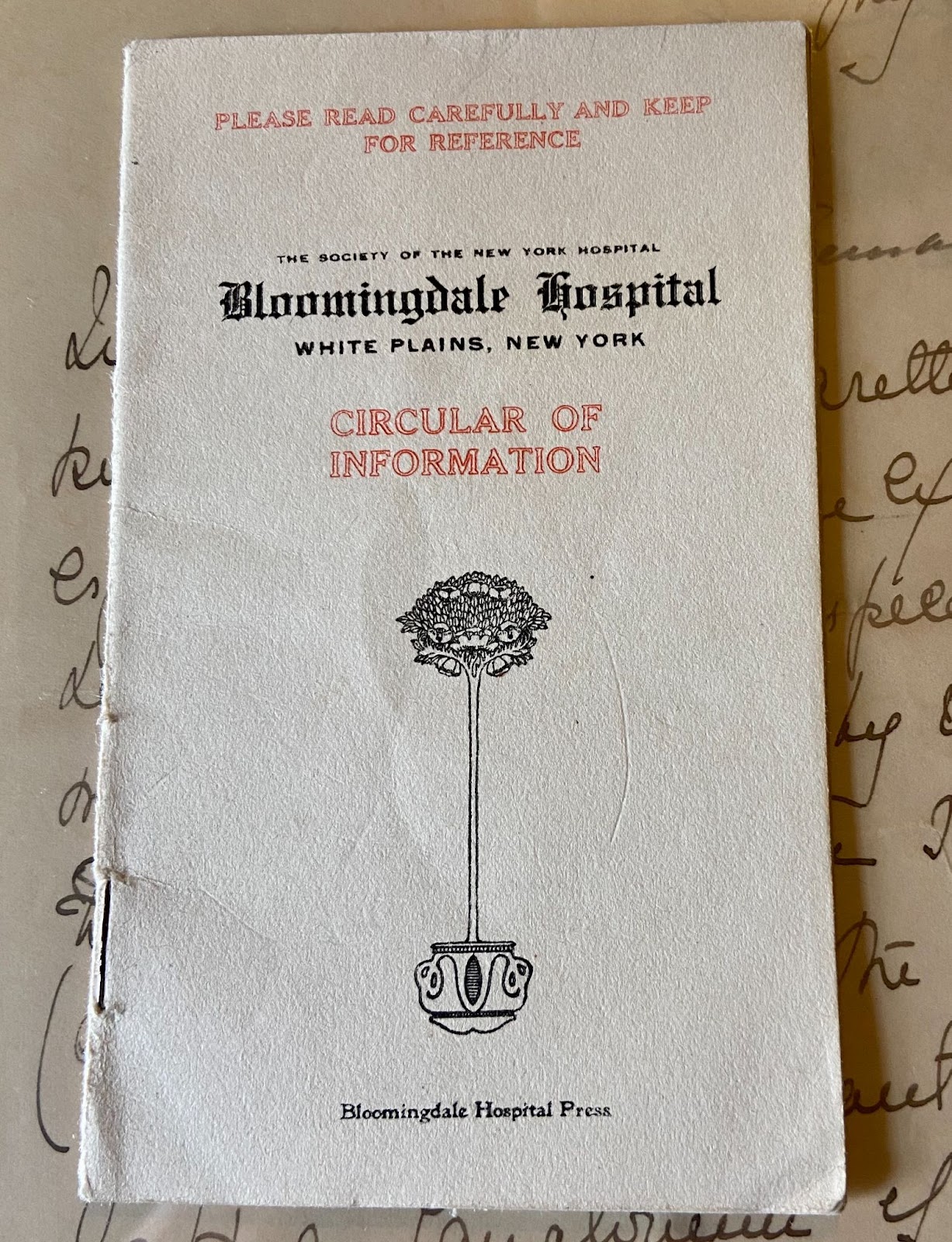
Dr. Freeman Allen wrote these words to his wife, Mary Ethel Gibson Allen, in 1926 while he was a patient at Bloomingdale Hospital in New York. A physician and pioneer in the anesthetics field, Freeman suffered from depression and narcotic addiction, and he spent the last five years of his life being treated in institutions. Throughout it all, he wrote letters to his wife, updating her on his health as well as relaying mundane matters like requests for bowties and candies. As an intern at the Gibson House Museum this spring, I was tasked with reorganizing the over 400 letters that comprise the Mary Ethel Gibson Allen and Dr. Freeman Allen correspondence sub-series. The letters span thirty-six years, starting with their over decade-long courtship and ending with his death by suicide in 1930. The true story of his death was discovered by the museum just a handful of years ago; this revelation is recounted in a blog post here. My work in the archives this semester allowed me to follow Freeman and Mary Ethel’s relationship from its timid beginnings to its resilience in the face of illness and shame.

Thursday, December 10, 2020

Little Women Clubs and Boston Philanthropy

Illustration by Jessie Wilcox Smith, c. 1915.
Louisa May Alcott’s Little Women, published just after the Civil War, was a runaway best seller that impacted generations of readers and significantly influenced American culture as a whole, through countless editions, versions, sequels, translations, images, plays, and films. Little Women was so compelling that it inspired young fans to create spontaneous clubs, such as the “Little Men and Little Women,” the “Alcott Reading Club,” and the “Alcott Literary Club.” Inspired by the March sisters’ Pickwick Portfolio, five sisters from a small town in Pennsylvania created a family newspaper in 1871 that boasted a thousand subscribers nationwide before winding down a few years later.
     
A charming spinoff, The Little Women Club (1905), by Marion Ames Taggart, a children’s book about four friends aged eleven to thirteen who decide to form a club and who enact the novel in their daily lives, seeded Little Women Clubs across the United States. The clubs became so popular that adults soon took notice and began taking control. Some clubs were created to preserve the Alcott homestead, Orchard House, transforming it into a house museum. Young settlement workers followed the trend, creating a Louisa M. Alcott Club for Jewish immigrants, which aimed to “instruct small girls in all branches of housekeeping.” There was an Alcott Club sponsored by Hull House in Chicago, and a San Francisco chapter of the Little Women Club that provided poor children with “practical and moral training” and a few weeks of country life under the care of settlement workers. Little Women Clubs became generally associated with mental cultivation, character development, and philanthropy.

In December of 1905, Rosamond Warren Gibson attended a Congregational church fair in Norwood, Massachusetts, which was sponsored by the “Mission Circle” and the “Little Women.” Rosamond was on the Committee of Arrangements. Cake and candy tables, a fancy table (featuring precious or whimsical handmade items for sale), and a photo and art table were all well patronized. Entertainment consisted of a cantata entitled Santa Clause’s Mistake, a dumbbell drill by two squads of girls, with piano accompaniment, and “a tambourine drill in Spanish costume by 12 young ladies.” Designed to promote mental cultivation, character development, and philanthropy, Little Women Clubs were an outgrowth of two important social trends spanning the late nineteenth and early twentieth centuries: the women’s club movement and the settlement house movement.

Wednesday, September 23, 2020

Power in Suffrage

This blog post is part of a series about the Gibson family and the lead-up to the 1920 presidential election, which promised "a return to normalcy" after many years of social upheaval. Read about Boston's experience of World War I here and Boston during the flu epidemic of 1918 here.

The first two decades of the early twentieth century saw huge social movements in the United States, most notably the suffrage movement. Women had been fighting for their right to vote for many years, but the movement gained more traction in the 1910s. Women across the country marched, protested, and rallied for suffrage. An anti-suffrage movement also existed, largely driven by white, upper-class women. These women, although still second-class citizens in the United States, possessed a degree of relative privilege due to their race and class. The Gibsons belonged to this group, and the Gibson women used their position to advocate against women’s suffrage. 

Mary Ethel, the oldest Gibson daughter, was an anti-suffragist. In 1914, she and many other Back Bay women sold red roses to the public just ahead of a suffrage parade. As red was the color of anti-suffrage, the women intended for the thousands of roses to make a “dignified protest” against the suffragists in Boston. She protested alongside other women from her social circle during this event. Mary Ethel may have also participated in other anti-suffrage events in Boston; her sister and mother may have felt similarly about the cause.

Boston Globe, October 17, 1915.

The upper-class culture of Beacon Street led to its becoming a center of anti-suffrage in Boston. In fact, suffragists in Boston called the street “enemy’s country” because of its large anti-suffragist population. These privileged women could not take part in governmental politics, but were able to be involved in and influence the social politics of their upper-class culture through their connections. 

Tuesday, September 22, 2020

Epidemic in the City

This blog post is part of a series about the Gibson family and the lead-up to the 1920 presidential election, which promised "a return to normalcy" after many years of social upheaval. Read about Boston's experience of World War I here and the Gibsons and suffrage here.

In the spring of 1918, in the midst of World War I, an influenza virus called Spanish Flu (or “Grippe”) because it was believed to have originated in Spain, spread through the United States. A lethal second wave began that summer in Boston. Much like the waves of the COVID-19 pandemic we are currently experiencing, the influenza of 1918 turned daily life upside down. 

Influenza cropped up in Boston in late August of 1918 at Commonwealth Pier, where sailors trained before going overseas. Like the rest of the country, Boston was fully immersed in wartime efforts. Over 100,000 male Bostonians between the ages of eighteen and forty-five registered to be drafted in early September. The federal government’s Liberty Bond campaign to offset the cost of war was in full swing, with Boston expected to raise 129 million dollars through the sale of bonds at Liberty Loan parades and drives. 

Boston Globe, September 2, 1918.
A “Win-the-War-for-Freedom” Labor Day parade held on September 2, 1918, consisted of 4,000 people; civilians, soldiers, and sailors from Commonwealth Pier mingled, spreading the virus among Boston residents. The parade wound around Boston Common, quite close to the Gibson family home at 137 Beacon Street. 


Charlie Gibson, Boston, and the War in Europe

This blog post is part of a series about the Gibson family and the lead-up to the 1920 presidential election, which promised "a return to normalcy" after many years of social upheaval. Read about the Gibsons and suffrage here and Boston during the flu epidemic of 1918 here.

Charlie Gibson, a Citizen Soldier: The Plattsburg Movement and the First World War 

On May 7, 1915, a German submarine torpedoed and sank the HMS Lusitania, a British cruise liner traveling from New York City to Liverpool, England. Almost twelve hundred people died in the attack, including 123 Americans. 


Gibson House Museum
For almost two more years, President Woodrow Wilson maintained official neutrality and a policy of American isolation. Others in the United States believed that American entry into the conflict was inevitable and joined the Preparedness Movement, an effort to ready American troops for war. Led by individuals such as former president Theodore Roosevelt and General Leonard Wood, the Preparedness Movement gained much of its membership from upper- and middle-class Americans in the Northeast. 

Thursday, August 20, 2020

Part 3: The Poet

This post is the third of a three-part series on the life and writings of Charles Hammond Gibson, Jr., founder of the Gibson House Museum. You can read the first part here and the second here.

The mysteries of our lives resolve themselves very slowly with the progress of years. Every decade lifts the curtain, which hides us from ourselves, a little further, and lets a new light upon what was dark and unintelligible.

—Oliver Wendell Holmes, 1896

A portrait of the artist as a young man: independent and well-traveled, Charles Hammond Gibson, Jr. (1874–1954), the bachelor-poet of Boston, achieved early success. His first two books, Two Gentlemen in Touraine (1899) and Among French Inns (1905), both on French

Charles Hammond Gibson, Jr., c. 1920.
travel, were so popular they went into second editions. In Two Gentlemen in Touraine, Gibson explored the art, architecture, and social customs of rural France, depicting it as an enchanted “fairyland,” a greenwood and pastoral escape route in the gay Arcadian literary tradition of the Victorian era—in sharp contrast to the cooler, monochromatic stones of old Beacon Street. As explored in the second blog post in this series, Two Gentlemen in Touraine told a thinly veiled autobiographical tale of initiation into the transatlantic gay subculture of the 1890s, with the Count Maurice Mauny Talvande as guide and mentor. Among French Inns takes the form of a travel book embedded in a comic novel—a farce—containing a wry parody of Isabella Stuart Gardner and John “Jack” Lowell Gardner, Jr. in the character of Mr. and Mrs. James Blodget Wilton.

Gibson’s first love, however, was poetry, and in the first decade of the twentieth century he produced two substantial volumes, The Spirit of Love and Other Poems (1906) and The Wounded Eros (1908). Working closely with the Riverside Press of Houghton Mifflin, he planned to produce a total of four volumes, to be bound as an elegant set, including Odes and Elegies (1908) and Dialogues and Satires (1909). The last two volumes were never produced, although most of the poems were prepared in manuscript.

Wednesday, July 22, 2020

Part 2: Two Gentlemen in Touraine: A Pilgrimage to Fairyland

This post is the second of a three-part series on the life and writings of Charles Hammond Gibson, Jr., founder of the Gibson House Museum. You can read the first part here. 

Let us then take a sweeping glance around, for we may not have another half so grand, half so fair, or half so high, while we are in the old Touraine which lies before us, there in the last orange glow of the departed sun. And if we follow these avenues of the roof below us, if we wind our way around these great towers, around the high and pointed roofs of slate, we may well imagine ourselves in some fairyland. This maze of cupolas, of domes, of towers, appears more bewildering to us than ever. And we lean against the stone, in an artistic intoxication, so overpowering is it.


—Charles Hammond Gibson, Jr., Two Gentlemen in Touraine (1899)


In 1899, when Charles Hammond Gibson, Jr. (“Charlie”) published Two Gentlemen in Touraine, a lighthearted but sophisticated book about the historic and picturesque French royal chateaux of Touraine, he was just twenty-four years old. A young Bostonian educated at elite New England prep schools, he also briefly attended the Massachusetts Institute of Technology, where he became captivated by French history and architecture. Charlie had talent, a refined sensibility, and an entrepreneurial spirit. His family, part of the last wave of Boston’s Brahmin elite, wanted him to become an engineer of some kind and so sent him off to MIT, then called Boston Tech and located, like his family’s fashionable brownstone residence, in the Back Bay. Charlie would later recall that he resisted such a utilitarian path. “I wanted only to create beauty, and, through my verse and my garden, I think I’ve done that.”

In the twilight of the Brahmin era, estates and inherited wealth were divided and subdivided; young men had to pursue careers and establish themselves, socially and financially. And so Charlie’s decision to become a traveling bachelor-poet created tension at home, especially with his father, Charles Gibson, Sr. Although mitigated by a close and loving relationship with his mother, Rosamond Warren Gibson, this tension would come to define his life in significant ways. A similar pattern of intra-familial conflict would play out with other gay men of Charlie’s generation, and beyond, in legal struggles over inheritance and, in some cases, disinheritance.

Manuscript copy of the first chapter of Two Gentlemen in Touraine.
Collection of the Gibson House Museum


Friday, April 24, 2020

Part 1: The Wounded Eros

This post is the first of a three-part series on the life and writings of Charles Hammond Gibson, Jr., founder of the Gibson House Museum. Stay tuned for parts two and three in the coming months.

Gibson in his rose gardens
at Forty Steps, c. 1910.

How does one measure a life dedicated to poetry, a writing life?   Charles Hammond Gibson, Jr. dedicated his entire adult life to the art of poetry, as poet, critic, editor, and literary personality.  He published his first poem in the Boston Transcript in 1894, and, toward the end of his career, he quipped to a curious listener at one of his many public readings, “My dear lady, I have been writing poems for fifty years.  They are like the droppings of pigeons all over the house.” His manuscripts overflowed from portfolios, closets, desk drawers, cabinets, drawing rooms, and even toolsheds! In some ways, Gibson’s poetry was closely connected to the domestic spaces he crafted, curated, and inhabited--his “Victorian Museum,” the Gibson House, and the spectacular gardens of his family’s exclusive summer residence, Forty Steps, Nahant. Like many traditional poets of the late nineteenth and early twentieth centuries, Gibson’s work is highly context-dependent.  His poems tend to be formal, referential, commemorative, and backward-looking--vintage before their time--the kind of poetry that was almost completely obscured by the advent of literary modernism.  On the other hand, viewed holistically, there is a compelling sense of quirky humor, passion, historicity, and mystery about Gibson’s writing, a body of work peppered with veiled autobiographical fragments that conceal as much as they reveal.

Wednesday, February 6, 2019

The Sound of Music: The Importance of Music in Victorian Homes


Listening to music within the home was something that was deeply cherished among Victorians of all social classes. In a world that was limited to objects such as music boxes to reproduce sounds in the home, live music was especially appealing. Many forms of outside entertainment were sought after, but attending these events could prove inconvenient given New England's challenging weather and limited transportation options. Naturally, it made sense to bring the entertainment into one's home, thereby giving rise to the presence of a “music room” within many upper-class Victorian houses. At the Gibson House, the music room is the most lavish room and was a place where the Gibson family regularly entertained guests and friends.  

Mason & Hamlin Symmetrigrand Piano, 1908
Gibson House Museum (2006.08)
The piano became an especially fashionable musical instrument to possess, either an upright or a baby grand, depending on the wealth of the family. Since at the time many popular songs were made available in sheet music form, amateur musicians could play to their guests and family. There is quite an extensive collection of sheet music at the Gibson House Museum, collected over the years by the family. Along with individual pieces, there are bound albums containing a number of miscellaneous works, such as polka music and waltzes. The majority of the music is from the late nineteenth through the early twentieth centuries (1879–1934), and was largely published in Boston. (The name Oliver Ditson & Co. appears often, indicating it was, perhaps, the family’s company of choice when purchasing new music.) The Gibson family’s music collection contains many pieces by well-known classical composers, including works like Fugue in G Minor (The Little) by J. S. Bach and Danse Polonaise by Xaver Schwarwenka, which you can listen to here and here.

Wednesday, November 7, 2018

A Century of Easton Living


This blog post is part of an occasional series about Gibson family relatives. Family trees are rife with personalities: the mysterious aunt, the curmudgeonly great-uncle, the adventurous second cousin. Join us as we explore some of these colorful characters and learn more about the interconnected nature of Boston high society in the process.

On September 2, 2018, Elizabeth Motley Ames died at the age of 99. She had lived just shy of an entire century in Boston and Easton, Massachusetts.  A great-niece of Rosamond Warren Gibson’s, she was a passionate preservationist and a longtime supporter of community causes in Easton.

Eleanor Warren (left) and Rosamond Warren (right),
circa 1870.
Gibson House Museum (1992.406.1).
The Motley family lived nearby to the Gibsons in Back Bay. Sisters Rosamond and Eleanor Warren were quite close growing up, born only a year apart; they remained so after they were married. Family lore has it that when the Motley kids walked past 137 Beacon Street, on their way to or from the Public Garden, they’d better not be misbehaving or great-aunt Rosamond would be sure to tell grandmother Eleanor about it straight away. Boston’s Back Bay was a tight-knit community into the early twentieth century.

As a young woman, Elizabeth Motley married into a prominent Easton family. Oliver Ames (1779–1863) founded a shovel factory in Easton, Mass. which would go on to become a world-class operation, involved in many key construction events in American history. The Ames family also included several politicians over the years, most notably Oliver Ames (1831–1895) who served as governor of Massachusetts in the late nineteenth century.


Tuesday, June 5, 2018

Rooms With a View: Seeing Victorian-Era Boston through Queer Eyes

The Red Study
This blog post is a preview of an article that originally appeared in the Boston Pride Guide 2018.
Be sure to follow the link at the end of the preview to read the rest of the article. 

As you wind your way up the staircase of the Gibson House Museum, you leave behind the public spaces of this elegant Back Bay townhouse and enter the family’s private quarters. The third floor was formerly the master bedroom suite—two separate bedrooms linked by a shared bathroom, as was common in wealthy 19th-century homes—of Charles Hammond Gibson, Sr. and Rosamond Warren Gibson, from their marriage in 1871 until Charles’s death in 1916.

What used to be Charles Gibson, Sr.’s bedroom is now the Red Study. It’s an apt name. The carpet is crimson; the walls and drapes a rust-red. The room is packed tightly with furniture: armchairs—also red—by the small fireplace, a desk, and several tables. Even a sofa is tucked in. In the years following Charles, Sr.’s death, this room became the domain of Charles Hammond Gibson, Jr. Known by his family as “Charlie,” he was the second of Charles and Rosamond’s three children, born in 1874. We can learn much about Charlie simply by looking at the objects that fill this brooding, close space: his books on the desk, with several ashtrays nearby; his portable projector on the center table; framed letters from American and British notables, thanking him for his thoughtful words; a memento from the Revolutionary War. Charlie’s story is both at the heart of the museum—he was, after all, the museum’s first curator—and shrouded in some mystery, as his status as a lifelong bachelor provoked some rumor and conjecture over the years.


-Meghan Gelardi Holmes, Curator

To read the rest of this article, visit: Boston Pride Guide 2018. 


Tuesday, February 7, 2017

A Housekeeper's Scrapbook


Domestic life of the mid-nineteenth and early-twentieth centuries is illuminated at the Gibson House through its authentically preserved rooms and collections. One item that provides insight into the house’s history of domestic service is a paperback entitled “A Housekeeper’s Scrapbook.” Located in the kitchen pantry on the ground floor, the volume contains a collection of printed recipes, as well as loose clippings of other recipes and home remedies.
This scrapbook is a simple encapsulation of one aspect of servant activity—kitchen work—and is instrumental to the telling of the story of servant life during this time period. The meticulously detailed recipes reflect the specificity and accuracy required of a household cook.  
Many house museums like the Gibson House are constantly trying to discover more information about their domestic staff and making efforts to incorporate their stories into the site’s larger narrative. The history of servants, many of whom were Irish, is a significant part of not just the Gibson House story, but of Boston’s history. The wave of Irish immigration in the nineteenth century helped make Boston the city it is today.


By Emma Rose Cunningham, museum intern

Tuesday, September 6, 2016

The Gibson Ladies and the Vincent Club


A century ago, most Bostonian women of a certain social standing participated in any one of the numerous, yet highly exclusive, women’s clubs in the city. Exclusivity characterized the nature of the clubs, but the majority actually focused their energy on various types of charity work—a noblesse oblige approach to social groups.

The Vincent Club was one such philanthropic organization. Founded in 1892, the club originated to support the Vincent Memorial Hospital, established one year earlier in the memory of Mary Ann Vincent, a magnanimous Boston actress. The Vincent Memorial Hospital, originally located in the West End, filled a niche in Boston; the hospital’s medical staff cared primarily for wage-earning, indigent women.

Vincent Club fundraising techniques exceeded the common luncheon. The club’s annual fundraising show—a vaudeville performance inspired by Mary Ann Vincent’s theatrical career and featuring the “Vincent Ladies”—arrived on the social scene every year beginning in 1893 to great anticipation. The “Vincent Show” typically took the form of a topical satire, featuring Boston’s finest young women performing a multitude of acts. Themes ranged from the inaugural “Breaking the Ice” show to the 1959 musical depicting life on an “interplanetary space platform.” The show also served as a light-hearted debutante ball, in which young women made their “stage debut as singers and dancers.”

Unlike a traditional debutante ball, however, there was a strict ladies-only rule on stage and in the audience. In 1899, the Boston Daily Globe published its annual Vincent Show preview feature, stating, “It was distinctly stated and printed on the tickets that no gentlemen would be admitted…. [T]hose who appeared in the leading roles had the supreme confidence of appearing before a friendly audience and were as much at ease as if entertaining in their own drawing rooms.”

Mary Ethel Gibson (1873–1938), referred to in the Boston Daily Globe as having “always been popular in society,” was a founding member of the Vincent Club along with her mother, Rosamond Warren Gibson (1846–1934). Rosamond planned and directed the first theatrical performance, while Mary Ethel performed in that 1893 show, starring as a man named Lord Adonis Fickleton.

In 1941, the Vincent Memorial Hospital merged with Massachusetts General Hospital, providing gynecology services while maintaining its own identity. When the Vincent let its independent hospital license expire in 1988, MGH agreed to keep the VMH’s name associated with its former programs. 

The Vincent Club is still extant, with a current membership of 1,200 women. A fancy spring gala has since replaced the Vincent Show as the main fundraising event. Male attendees are welcome at the gala, as the “no men allowed” rule was rescinded in 1920.

By Maddie Webster, museum guide and intern


Sources
“Boston's Vincent Club: Elite and Thriving.” New York Times (1923–Current File), Feb. 20, 1971. http://proxy.bc.edu/login?url=http://search.proquest.com.proxy.bc.edu/docview/119389407?accountid=9673.

Laura Haddock, “Traditional Vincent Club Drill to Renew Memories of Show’s Women’s Activities.” The Christian Science Monitor (1908–Current File), Feb. 28, 1947. http://proxy.bc.edu/login?url=http://search.proquest.com.proxy.bc.edu/docview/515991751?accountid=9673.

“History,” Vincent Memorial Hospital, http://vincentmemorialhospital.org/history/.

“Mary Gibson a July Bride.” Boston Daily Globe (1872–1922), Jul. 21, 1911. http://proxy.bc.edu/login?url=http://search.proquest.com.proxy.bc.edu/docview/501764479?accountid=9673.

“Society Women in a Vaudeville Show.” Boston Daily Globe (1872–1922), Apr. 28, 1899. http://proxy.bc.edu/login?url=http://search.proquest.com.proxy.bc.edu/docview/499054147?accountid=9673.

“Vincent Club Headliners Through.” Boston Daily Globe (1928–1960), Mar. 22, 1959. http://proxy.bc.edu/login?url=http://search.proquest.com.proxy.bc.edu/docview/250878367?accountid=9673.

“Vincent Club Revue Promises Gala Opening.” Boston Daily Globe (1928–1960), Mar. 8, 1936. http://proxy.bc.edu/login?url=http://search.proquest.com.proxy.bc.edu/docview/815157287?accountid=9673.

Gail Wetherby, e-mail message to the author, August 12, 2016.


Tuesday, August 23, 2016

Charlie Gibson’s Prison Reform League Targets the Deer Island Prisons


Charles “Charlie” Hammond Gibson, Jr., often referred to as “Mr. Boston” by neighbors, was deeply involved in his community. Ever the public servant, he volunteered in various city government departments and interest groups over the years. Making a foray into the social movement known as progressivism, Charlie proposed significant prison reforms as the secretary for the Massachusetts Prison Reform League from 1913 to 1916.

A principal concern of the League during that time was the bleak Suffolk County House of Correction on Deer Island. Since Boston’s earliest years, Deer Island had been designated as a place to send pariahs—a holding area for the enemy, the ostracized, and the ill. The island was first used as a detention facility for Indians during King Philip’s War in 1675, then as a quarantine station in the late 1600s and again in the 1840s for sick Irish famine refugees.

Thousands of society’s unwanted had been buried on Deer Island by 1858, when the House for the Employment and Reformation of Juvenile Offenders, a misdemeanor detention center for boys, was established there. Various incarnations of low-security prisons inhabited the area thereafter, most notably the Suffolk County House of Correction, which included two prisons, from 1882 until 1991.

Friday, July 15, 2016

Items from the Gibson House Collection: The White House Cook Book

The White House Cook Book

In the center of the Gibson House kitchen stands a table with a few objects on it, including a cookbook currently turned open to a page detailing various recipes for jumble, a ring-shaped cookie or cake. This cookbook is the 1905 edition of the White House Cook Book by Mrs. F. L. Gillette and Hugo Ziemann.


The title page describes the cookbook as “A comprehensive cyclopedia of information for the home, containing cooking, toilet and household recipes, menus, dinner-giving, table etiquette, care of the sick, health suggestions, facts worth knowing, etc.” Wondering what “toilet recipes” entail? As it turns out, homemakers could mix together natural ingredients for almost any personal care or beauty aid they might have needed: “hair invigorator, lip-salve, and instantaneous hair dye” are but a few of the toilet recipes in the book.

Friday, July 1, 2016

Glory in the Garden, Folly in the Common: The Gibson Family’s Presence in Boston’s Public Parks

The 1868 Ether Monument
Charles Gibson's Convenience Station
Last month, museum docent Timothy Spezia wrote his final blog post on Dr. John Collins Warren, grandfather of Rosamond Warren Gibson, and his groundbreaking use of ether in 1846. Coincidentally, while walking through the Boston Public Garden a few days ago, I happened to notice a monument in the northwest corner. I had seen it before but never thought anything of it; compared to the grand equestrian statue of George Washington amongst the flowers nearby, this monument is more subdued under the shade of trees. Upon further inspection, and much to my surprise, the structure revealed itself as the 1868 Ether Monument.

The Ether Monument does not memorialize one person, but rather the historic MGH operation when dentist William T. G. Morton assisted John Collins Warren in using ether as an anesthetic for the first time. Atop the granite tower kneels the Good Samaritan aiding a wounded stranger. The tower’s four sides feature an assortment of scenes and inscriptions illustrating medically relevant themes. The monument’s status as the oldest in the Garden—preceding the George Washington statue by one year—makes it evident that Bostonians highly valued this medical advance and took pride in the historic operation.


The Ether Monument, which is not far from the Gibson House, commemorates a valued contribution made by a Gibson relative to Boston, the United States, and the world. On the other side of Charles Street, on the Boston Common, stands another Gibson family–related structure: one that became shrouded in controversy despite its planners’ good intentions.