Showing posts with label archives. Show all posts

Tuesday, September 10, 2024

Mary Ethel Gibson: An Emblem of Boston's Victorian Era

The research for this blog post was conducted in preparation for an interview with the What’s Her Name podcast in 2023. To learn more fascinating details about Ethel’s life, listen to their episode, “The Boston Brahmin.”

Ethel and husband Freeman Allen, c.1925
Gibson House Museum
Mary Ethel Gibson, born in 1873—and more often referred to as Ethel by friends and family—was brought into a world on the precipice of great change. Over the course of the first few decades of her life the telephone was invented, as was the automobile and kodak camera; electricity made its way into homes; and even the first airplane took flight. The city of Boston itself was also changing, as waves of immigration created a massive population boom, which not only encouraged the city to create the Back Bay neighborhood that Ethel would spend her entire life in, but also created new social pressures that sparked various progressive movements. At the Gibson House, as we have begun to uncover more details about Ethel’s life, we can see the ways in which she navigated these changes, both by holding on to the traditions she grew up with and by taking advantage of the newfound freedoms afforded to her in the 20th century. Ethel’s community and her status in society informed and shaped her life during such rapidly changing times. In many ways, Ethel and her experiences during the 19th and 20th centuries are emblematic of Boston’s Victorian era, but she was also an individual who made individual choices. No one person’s story is enough to understand any period of history, but knowing more about Ethel and her life not only expands our understanding of the Gibson House and the Gibson family, but also the greater world they occupied.

Thursday, February 24, 2022

The Acquaintance of Charlie Gibson, Jr. and Isabella Stewart Gardner

Oftentimes visitors to the Gibson House Museum ask our guides about Charlie Gibson Jr.’s relationships with other well-known Bostonians, especially Isabella Stewart Gardner. Although the two were neighbors for nearly forty years, there is not much evidence that they were close. (Isabella Stewart Gardner was both a generation older than Charlie and was part of a higher social class.) There is, however, evidence that they were acquaintances. Isabella Stewart Gardner was, and still is, considered one of the most prominent, and perhaps
Drawing Room at 152 Beacon Street, 1900.
Image: Gardner Museum
eccentric, members of Boston’s elite in the nineteenth and twentieth centuries. She was born in New York City in 1840 to a wealthy family. In 1860, just before she turned twenty, she married Jack Gardner and they moved to Boston, to 152 Beacon Street in the Back Bay. Although the couple traveled abroad quite a bit, Beacon Street was their home until Jack’s death in 1898, after which Isabella purchased land in the Fens for the museum and home they had been planning. During this same period, Charlie Gibson was born (1874), grew up in the Back Bay at 137 Beacon Street, and went on the trip to France which inspired his travelogue,
Two Gentlemen in Touraine (1899). The Gibson family lived just two blocks from the Gardners during the entire time they resided in the Back Bay.

Thursday, July 15, 2021

In Sickness and In Health: Dr. Freeman Allen, Mary Ethel Gibson, and Mental Health and Addiction

This blog post is part of an occasional series about the Gibson House Museum Archives, a repository of personal documents and photographs from the Gibson family. The archives are accessible by appointment; contact mgholmes@thegibsonhouse.org to make arrangements.

“I said that although I had always thought that it might be best to resume work in Anesthesia on a moderate scale, that you had absolutely declined to have me do this and that I had definitely made up my mind to be guided by you in the matter, and that of course if you did not want me to do it and would not stand for it, that settled it. 

 . . . 

I will now follow your advice and take a rest before the walk which I hope will take place. 


I am, darling little Wesscat, with more love and gratitude than I ever felt before in my life, and many kisses for your sweet little self, 


Your affectionate husband 

Freeman”

Gibson House Museum Archives.

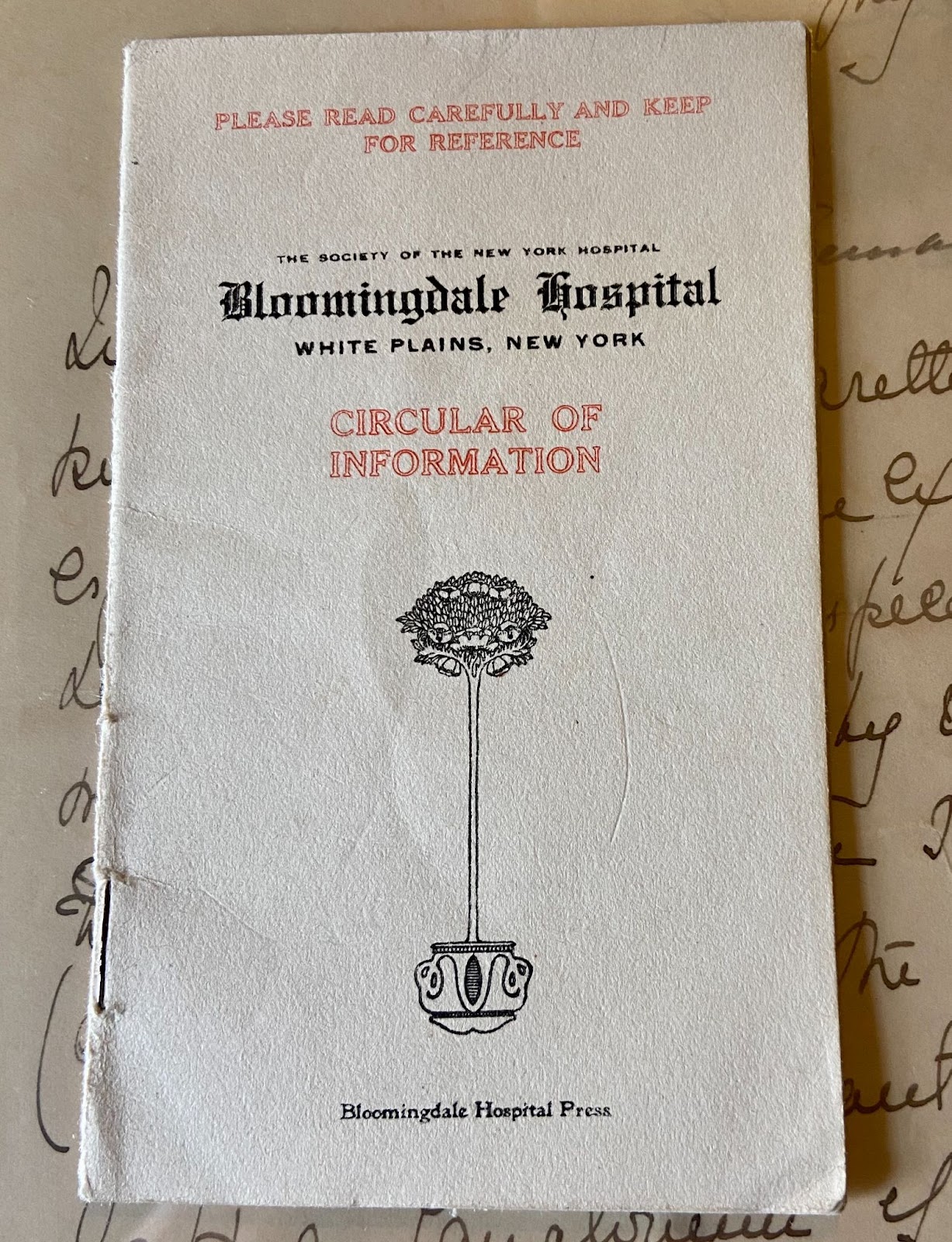
Dr. Freeman Allen wrote these words to his wife, Mary Ethel Gibson Allen, in 1926 while he was a patient at Bloomingdale Hospital in New York. A physician and pioneer in the anesthetics field, Freeman suffered from depression and narcotic addiction, and he spent the last five years of his life being treated in institutions. Throughout it all, he wrote letters to his wife, updating her on his health as well as relaying mundane matters like requests for bowties and candies. As an intern at the Gibson House Museum this spring, I was tasked with reorganizing the over 400 letters that comprise the Mary Ethel Gibson Allen and Dr. Freeman Allen correspondence sub-series. The letters span thirty-six years, starting with their over decade-long courtship and ending with his death by suicide in 1930. The true story of his death was discovered by the museum just a handful of years ago; this revelation is recounted in a blog post here. My work in the archives this semester allowed me to follow Freeman and Mary Ethel’s relationship from its timid beginnings to its resilience in the face of illness and shame.

Wednesday, August 14, 2019

Faking the Family Tree


Dining room at the Gibson House.
A family crest hangs over the dining room fireplace at the Gibson House. The vivid red and gold shield on a bright black background is eye-catching. Dinner guests would be unlikely to miss its not-so-subtle implications about the importance of the family lineage. In a scroll along the bottom, the motto reads “In the name of Gibson.” 

The tradition of coats of arms (of which the crest is the top part) dates to the medieval period in Europe, where knights would carry shields with specific designs. The design elements were intended to convey the achievements of the person who carried the coat of arms. Later, families would take a coat of arms as the family logo.  Typically, only noble families were permitted to do this and so the coat of arms came to be associated with the aristocracy. 


Friday, June 1, 2018

From Leisure to Danger: A Gibson Family Vacation on the Verge of War


This blog post is part of an occasional series about the Gibson House Museum Archives; a repository of personal documents and photographs from the extended Gibson family. The archives are accessible by appointment; contact curator@thegibsonhouse.org to make arrangements.

The Gibsons were not just devoted Bostonians, but avid world travelers as well. Multiple photo albums received as part of a recent donation to the museum by Gibson family descendant Rosamond Warren Allen document Mary Ethel and Rosamond Gibson’s travels throughout Europe in the early twentieth century. With the birth of their sons—Henry Freeman Allen and Warren Winslow, respectively—their travel bug only spread. The photo albums that all of these members of the Gibson family created allow us to not only look back at their distinctly personal moments, but also discern their opinions on and relationship to the world outside of Boston.

Friday, March 2, 2018

Charlie Gibson, Lodger


This blog post is part of an occasional series about the Gibson House Museum Archives, a repository of personal documents and photographs from the Gibson family. The archives are accessible by appointment; contact curator@thegibsonhouse.org to make arrangements.

In  1940, Margaret MacDonald came to work as a cook at 137 Beacon Street. Charlie Gibson, Jr. had been living at the house, largely alone, for the previous six years and from a statement Ms. MacDonald signed, it sounds like things were not going all that well.
Ms. Mary MacDonald’s signed statement, April 18, 1940. This was likely written by Charlie and signed by Ms. MacDonald in response to a dispute with a previous employee at 137 Beacon Street.

“I arrived at 137 Beacon Street, on April 9, 1940, to work as cook and house-maid, and found the condition of the kitchen dirty and uncleanly, dishes shelves and utensils not properly cleaned or kept. They showed signs of gross neglect by the cook who had last been in charge of them.”

Tuesday, February 7, 2017

A Housekeeper's Scrapbook


Domestic life of the mid-nineteenth and early-twentieth centuries is illuminated at the Gibson House through its authentically preserved rooms and collections. One item that provides insight into the house’s history of domestic service is a paperback entitled “A Housekeeper’s Scrapbook.” Located in the kitchen pantry on the ground floor, the volume contains a collection of printed recipes, as well as loose clippings of other recipes and home remedies.
This scrapbook is a simple encapsulation of one aspect of servant activity—kitchen work—and is instrumental to the telling of the story of servant life during this time period. The meticulously detailed recipes reflect the specificity and accuracy required of a household cook.  
Many house museums like the Gibson House are constantly trying to discover more information about their domestic staff and making efforts to incorporate their stories into the site’s larger narrative. The history of servants, many of whom were Irish, is a significant part of not just the Gibson House story, but of Boston’s history. The wave of Irish immigration in the nineteenth century helped make Boston the city it is today.


By Emma Rose Cunningham, museum intern

Tuesday, December 1, 2015

Letters from Pharaoh's Land Part I: Tourist Service on the Nile River


Cairo to Assouan: Map of the Nile River

 Twenty-one Days’ Trip from Cairo to First Cataract and Back, including the various Excursions as specified in the Itinerary, inclusive of Philae, donkeys (where required) to places visited on the river bank, provisions (wine excepted), and all the advantages in the Programme; FIRST-CLASS THROUGHOUT.

The above text, from an advertisement for the Thewfikieh Nile Navigation Company, appeared in the December 1895 edition of Gaze’s Tourists Gazette, the official publication of Henry Gaze and Sons, Ltd, a London travel agency. As the sole booking agent for the Thewfikieh Co., H. Gaze and Sons often advertised for the company, which provided tourist services on the Nile River. The same advertisement from which the above text is excerpted also outlined other important information, including price and the carrying capacity of the company’s fleet of steamships. In 1895, for the price of $171.50, a tourist could book passage on a steamship and spend three weeks on the Nile, soaking in the natural landscape and studying all the ancient ruins alongside the river.

Thursday, July 9, 2015

Letters from Cuba: Fourteen Months as an Army Surgeon


“I am writing this letter from the camp of the 7th US Cavalry with two troops of which I have been out on a practice march since Jan’y 13th. . . . We are now in our third week and on our way home and we hope to reach Havana in about five days. I have a fine little horse that I have had for about 6 months and he is standing the march splendidly.”
These words Dr. Freeman Allen wrote from Cuba to future wife Mary Ethel Gibson in January 1901. The doctor had been in Cuba for a year by that point, hired on contract by the US Army as acting assistant surgeon in western Cuba. Altogether, the young army doctor spent fourteen months on the island as part of the American occupation force in the years after the Spanish-American War (Feb.–Dec. 1898).

Thursday, May 21, 2015

The Gibson Family in the Civil War: Part I

Catherine Gibson and her son Charles moved into the Gibson House in 1860. One year later, the American Civil War began. Enquiring minds sometimes want to know: How was the Gibson family involved in the Civil War, if at all?


The answer is somewhat dissatisfying. We aren’t really sure. Charles didn’t enter the war. And that’s pretty much the extent of our knowledge. Years later, Charles married Rosamond Warren, who included some notes about the Civil War in her memoirs. She was born in 1846, so she was only about 15 when the war began. Here’s what she has to say:


“The war continued for four years, and it seemed to us as if it was going on forever. As we were so young, and had no immediate relatives concerned in it, I have no vital recollections in connection with it, save possibly a visit of General McLellan [sic] to Boston, and later a trip to New Orleans.