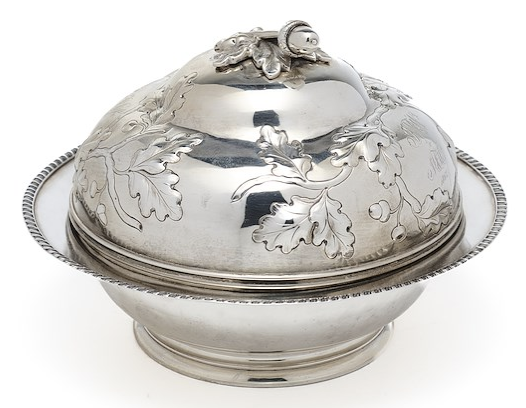
| Butter cooler, Vincent Laforme, Boston, c.1850 Collection of Gibson House Museum |
Thursday, May 15, 2025
Collection Spotlight: Butter Cooler
Thursday, January 30, 2025
Collection Spotlight: Stereoscope
These viewfinders mimic a much older object—the stereoscope. An invention of the nineteenth century, the stereoscope plays on our binocular vision to produce an exciting viewing experience. Two images—a left eye and right eye view of the same scene—are printed on a stereograph card, and when viewed through the stereoscope, appear as a single 3D image. The first stereoscope was debuted at the Great Exhibition of 1851, a world’s fair held in London, and quickly became popular on both sides of the Atlantic. Just five years later, more than a half million stereoscopes had been sold.
![]() |
| Stereoscope in the library, Gibson House Museum |
Tuesday, September 10, 2024
Mary Ethel Gibson: An Emblem of Boston's Victorian Era
| Ethel and husband Freeman Allen, c.1925 Gibson House Museum |
Tuesday, June 4, 2024
Collection Spotlight: Hair Wreath
![]() |
| Mourning brooch, Everhart Museum of Natural History |
Hair wreaths, in particular, became popular in the nineteenth century and were an especially common custom in the Victorian era (1837-1901). Unlike our example of a hair wreath, most of these objects are entirely made of hair–each braided arrangement carefully coiled together to resemble flowers. It was also common for these wreaths to contain the hair of multiple people and could be placed around a photograph. Some of the more intricate hair
![]() |
| Hair wreath, c.1875. Maine State Museum |
![]() |
| Courtesy of the College of Physicians of Philadelphia and Mütter Museum. |
Friday, May 24, 2024
Collection Spotlight: Asian Export Art
![]() |
| Porcelain lunch plate, teacup and saucer, and creamer, c.1840 Gibson House Museum |
![]() |
| Bed, John Vaughn, 1871 Gibson House Museum |
Friday, March 22, 2024
Artists Known: Two Dressmakers in Gilded Age Boston
Margaret Alice McKenna Friend was born around 1850 in New Ipswich, New Hampshire; Julia Evelyn Dobson Chapman between 1850 and 1857 in New Brunswick, Canada. The former would end up separated from her husband by 1900, with three daughters. The latter, who had no children, remained married to Everett Chapman, with whom she ran a dressmaking business, until her death.
The two women's paths converged in the same place: the Boston dressmaking world. Margaret first appears in the 1882 city directory working at 25 Winter Street; from then until her last listing in 1902, her business would move several times. The Chapmans seldom moved, settling at 579 Dudley Street in Roxbury from 1892 until their business closed in 1923.
Friday, August 25, 2023
Summering in Nahant
The Gibson family owned a summer home on Nahant called “Forty Steps,” named after the beach that the house overlooks. Catherine Gibson inherited the home from her father, Samuel Hammond, in the 1850s, and continued to summer there for most of her life.
![]() |
| Forty Steps, Nahant (Gibson House Museum) |
Tuesday, May 3, 2022
Venice and Boston: A 19th Century Love Affair
The icon is of St. Mark (San Marco), the patron saint of Venice. On the wall to its right is a copy of Flora, a well-known painting by Venetian Old Master Titian. If Paris is sometimes considered the essential European destination for American travelers today, Venice held the same appeal for late-nineteenth-century American travelers. It wasn’t necessarily a center for contemporary art or fashion; rather, it represented an old Europe that Americans found exotic and romantic. Venice was no longer an international powerhouse, but its Renaissance-era art and architecture reminded travelers of its previous glory (in a distinctly non-threatening way).
Friday, April 29, 2022
The 19th Century Allure of Roman Ruins
In 1898, after a year of study at MIT for architecture, Charlie Gibson took an extended trip to Europe. It was common for wealthy American men to make such a trip—to cap off their education and before settling down to work and family—known in nineteenth-century parlance as a Grand Tour. The Grand Tour could include a variety of European destinations (some even traveled as far as Turkey), but the essential stops were London, Paris, Venice, and Rome. Travel to Rome, in particular, was seen as a chance to complete a classical education, specifically through study of the architecture and history of ancient Rome.
Traveling to Rome was difficult in the nineteenth century. A robust tourist industry had developed by the eighteenth century, and yet transportation, lodging, and access to reliable guides remained sketchy. Some Italian architects and artists made a living serving Grand Tourists. Giovanni Batista Piranesi was one. Starting as early as 1740, Piranesi worked in Rome producing views of the ancient Roman ruins. For many, Piranesi’s depictions of Rome were the way they imagined and understood the city.
Thursday, February 24, 2022
The Acquaintance of Charlie Gibson, Jr. and Isabella Stewart Gardner
| Drawing Room at 152 Beacon Street, 1900. Image: Gardner Museum |
Wednesday, December 22, 2021
To Mold or Not To Mold: A History of Food Molds from the Victorian Era to Today
One notable feature of these objects is their versatility. Molds made of copper, pewter, or tin could be used for the baking, steaming, and setting of jellies, cakes, custards, and puddings. One type of mold in the Gibson kitchen is an ice cream mold, a technology pioneered by Agnes Marshall. Her 1885 seminal work, The Book of Ices: Including Cream and Water Ices, Sorbets, Mousses, Iced Souffles, and Various Iced Dishes, showed readers how to use her inventions, including molds and ice cream freezers, alongside recipes. Molded foods were conveniently labor saving for kitchen staff and women homemakers. They could be prepared around a day before the meal, then the mold could be removed just before serving.
Friday, April 2, 2021
1898 Mangle: Laundry Is the Mother of Invention
![]() |
| Trade card for the Bench Wringer Collection of Historic New England |
Thursday, February 11, 2021
Thomas Dalton, Boston Abolitionist (1794—1883)
The women of the Gibson Family—Catherine Hammond Gibson, Rosamond Warren Gibson, and Mary Ethel Gibson Allen—kept albums filled with photographs of relatives and friends. These images were typically studio portraits, traded as part of the custom of leaving calling cards when paying someone a social visit. At the Museum, we find them to be a helpful "who's who" of Boston, and especially the Back Bay, in the nineteenth century.Gibson House Museum( 1992.401.82)
In two different albums, Catherine included a photograph of Thomas Dalton. Dalton was a free African-American man born on the North Shore in Gloucester in 1794 who became a well-known activist and abolitionist in Boston's Black community. At the age of twenty-three, Dalton moved to Boston, where he first worked as a bootblack. He eventually opened his own used clothing store on Brattle Street and went on to become a prosperous merchant. His store, located near today's Government Center, was at the foot of the west slope of Beacon Hill, the center of Boston's Black community.
Thursday, December 10, 2020
Little Women Clubs and Boston Philanthropy
| Illustration by Jessie Wilcox Smith, c. 1915. |
A charming spinoff, The Little Women Club (1905), by Marion Ames Taggart, a children’s book about four friends aged eleven to thirteen who decide to form a club and who enact the novel in their daily lives, seeded Little Women Clubs across the United States. The clubs became so popular that adults soon took notice and began taking control. Some clubs were created to preserve the Alcott homestead, Orchard House, transforming it into a house museum. Young settlement workers followed the trend, creating a Louisa M. Alcott Club for Jewish immigrants, which aimed to “instruct small girls in all branches of housekeeping.” There was an Alcott Club sponsored by Hull House in Chicago, and a San Francisco chapter of the Little Women Club that provided poor children with “practical and moral training” and a few weeks of country life under the care of settlement workers. Little Women Clubs became generally associated with mental cultivation, character development, and philanthropy.
In December of 1905, Rosamond Warren Gibson attended a Congregational church fair in Norwood, Massachusetts, which was sponsored by the “Mission Circle” and the “Little Women.” Rosamond was on the Committee of Arrangements. Cake and candy tables, a fancy table (featuring precious or whimsical handmade items for sale), and a photo and art table were all well patronized. Entertainment consisted of a cantata entitled Santa Clause’s Mistake, a dumbbell drill by two squads of girls, with piano accompaniment, and “a tambourine drill in Spanish costume by 12 young ladies.” Designed to promote mental cultivation, character development, and philanthropy, Little Women Clubs were an outgrowth of two important social trends spanning the late nineteenth and early twentieth centuries: the women’s club movement and the settlement house movement.
Thursday, August 20, 2020
Part 3: The Poet
This post is the third of a three-part series on the life and writings of Charles Hammond Gibson, Jr., founder of the Gibson House Museum. You can read the first part here and the second here.
The mysteries of our lives resolve themselves very slowly with the progress of years. Every decade lifts the curtain, which hides us from ourselves, a little further, and lets a new light upon what was dark and unintelligible.—Oliver Wendell Holmes, 1896
A portrait of the artist as a young man: independent and well-traveled, Charles Hammond Gibson, Jr. (1874–1954), the bachelor-poet of Boston, achieved early success. His first two books, Two Gentlemen in Touraine (1899) and Among French Inns (1905), both on French
![]() |
| Charles Hammond Gibson, Jr., c. 1920. |
Gibson’s first love, however, was poetry, and in the first decade of the twentieth century he produced two substantial volumes, The Spirit of Love and Other Poems (1906) and The Wounded Eros (1908). Working closely with the Riverside Press of Houghton Mifflin, he planned to produce a total of four volumes, to be bound as an elegant set, including Odes and Elegies (1908) and Dialogues and Satires (1909). The last two volumes were never produced, although most of the poems were prepared in manuscript.
Thursday, July 9, 2020
The Gibson House Icebox
| Icebox. Gibson House Museum 2004.11 |
Friday, April 3, 2020
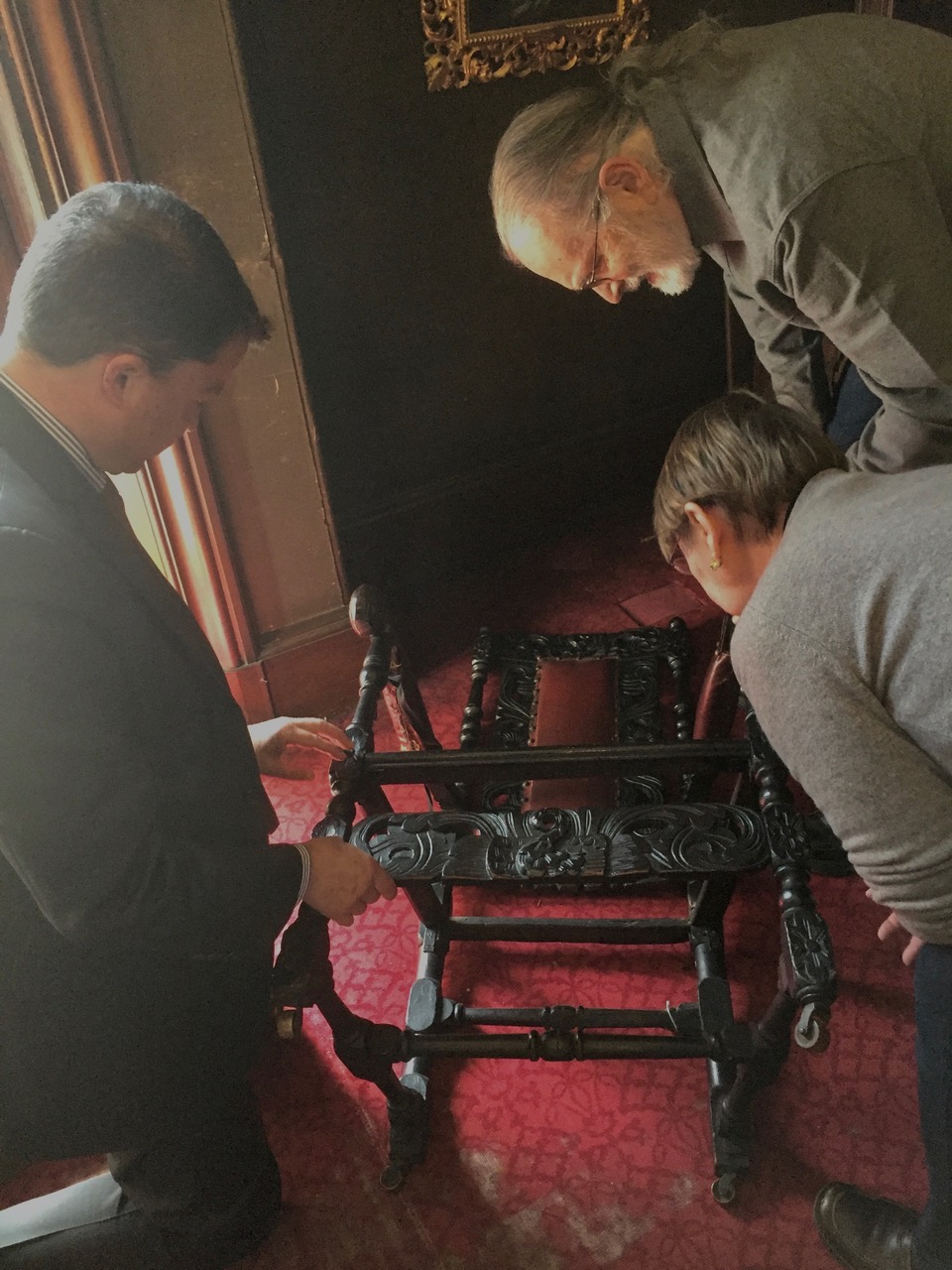
The Mystery of the High-Backed Chair
Friday, April 26, 2019
Finding Old-School Fashion in the Fast-Paced World
| Turquoise bodice, c.1870s Gibson House Museum (2019.3) |
Wednesday, February 6, 2019
The Sound of Music: The Importance of Music in Victorian Homes
![]() |
| Mason & Hamlin Symmetrigrand Piano, 1908 Gibson House Museum (2006.08) |
Friday, January 4, 2019
Matching Sailor Suits for the Gibson Cousins
| Henry Freeman Allen, c.1918 Gibson House Museum (2006.18.20) |