Showing posts with label furniture. Show all posts

Thursday, July 9, 2020

The Gibson House Icebox

Have you ever thought about what life was like before refrigerators? In 1830, a new invention changed the way Americans handled food: the icebox. 

Icebox.
Gibson House Museum 2004.11
At the Gibson House, an icebox can be found on the ground floor. It is a large, dark-brown box made from hardwood that looks almost like a drawer or large chest. It has multiple compartments to store different types of food; the compartments are lined with tin or zinc to insulate it. It is currently located in the kitchen, but originally it would have been kept outside the back door of the kitchen, on top of a zinc plate. 

Ice harvesting began here in Boston in 1805. Ice was harvested in the winter from frozen lakes and ponds and was delivered from house to house by an “iceman.” Frederic Tudor, one of the Gibsons' neighbors in Nahant, founded the Tudor Ice Company and later became known as Boston’s “Ice King.”  

The primary location of local ice harvesting in the 1850s was Jamaica Pond. By 1874, the Boston Globe reported that the Jamaica Plain Ice Company was cutting about 5,000 tons of ice a day. Prior to delivery, it was stored in insulated sheds that could contain up to 80,000 tons of ice. Once the ice was delivered, people would store it in their icebox, just like the one at the Gibson House.

Friday, April 3, 2020

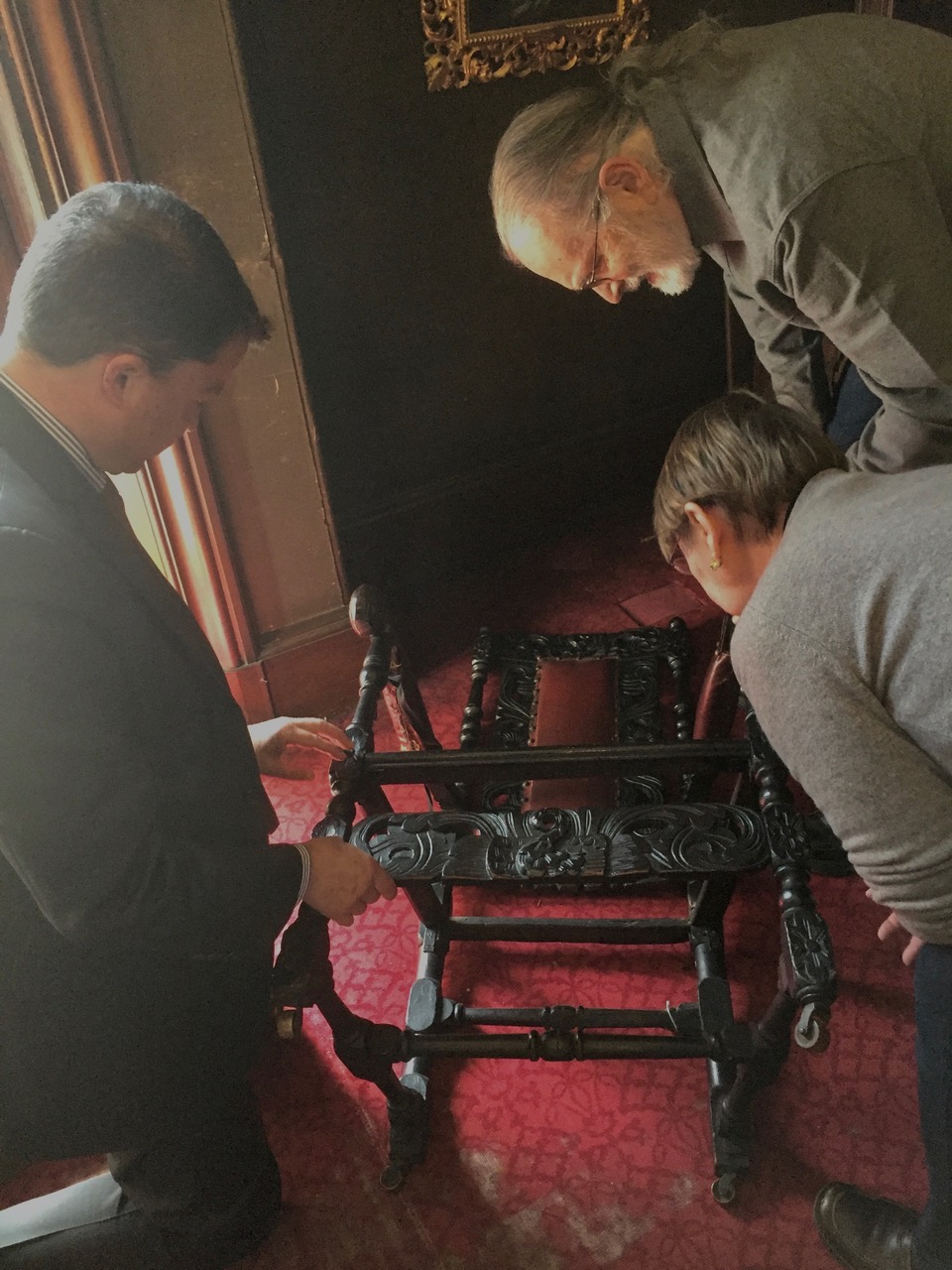
The Mystery of the High-Backed Chair

Tucked into a corner of the dining room at the Gibson House sits a high-backed armchair. In 2018, long-time museum patron Robert Severy offered to fund a restoration of this chair, as the red upholstery had cracked and faded. But what, exactly, would we be restoring? To solve this object mystery, we needed the help of two esteemed curators, a fabric reproduction specialist, and a restoration studio.
Thomas Michie and GHM board 
members examine chair.
Photo: Laurie Thomas

Wednesday, February 6, 2019

The Sound of Music: The Importance of Music in Victorian Homes


Listening to music within the home was something that was deeply cherished among Victorians of all social classes. In a world that was limited to objects such as music boxes to reproduce sounds in the home, live music was especially appealing. Many forms of outside entertainment were sought after, but attending these events could prove inconvenient given New England's challenging weather and limited transportation options. Naturally, it made sense to bring the entertainment into one's home, thereby giving rise to the presence of a “music room” within many upper-class Victorian houses. At the Gibson House, the music room is the most lavish room and was a place where the Gibson family regularly entertained guests and friends.  

Mason & Hamlin Symmetrigrand Piano, 1908
Gibson House Museum (2006.08)
The piano became an especially fashionable musical instrument to possess, either an upright or a baby grand, depending on the wealth of the family. Since at the time many popular songs were made available in sheet music form, amateur musicians could play to their guests and family. There is quite an extensive collection of sheet music at the Gibson House Museum, collected over the years by the family. Along with individual pieces, there are bound albums containing a number of miscellaneous works, such as polka music and waltzes. The majority of the music is from the late nineteenth through the early twentieth centuries (1879–1934), and was largely published in Boston. (The name Oliver Ditson & Co. appears often, indicating it was, perhaps, the family’s company of choice when purchasing new music.) The Gibson family’s music collection contains many pieces by well-known classical composers, including works like Fugue in G Minor (The Little) by J. S. Bach and Danse Polonaise by Xaver Schwarwenka, which you can listen to here and here.